
If you've been looking for ways to stop drafts and lower your energy bill in Killeen TX, the answer starts with understanding why your AC works so hard. Most Killeen homes have air leaks that aren't obvious from the inside. They hide at door frames, around window edges, behind outlet plates, and at attic access hatches. In a city where the AC runs from late April through October and summer electric bills regularly top $200, those leaks force your system to work 20 to 30 percent harder than a well-sealed home would require. Here's where the air goes and what to do about each location.
Why Air Leaks Hit Harder in Killeen Than Most Cities
Killeen's climate creates two conditions that amplify the cost of air leaks. First, the temperature differential between inside (76 to 78 degrees) and outside (94 to 102 degrees in July and August) is extreme. The bigger the gap between indoor and outdoor temperature, the faster conditioned air escapes and hot air infiltrates. Second, Killeen's expansive Vertisol clay soil shifts seasonally, expanding when wet in spring and contracting when dry in summer. That movement causes small but cumulative shifts in door frames, window frames, and foundation slab edges that open gaps in weatherstripping and caulk lines over time.
The result is a home that was reasonably tight when it was built but develops more and more air infiltration points as it ages. Homes in West Killeen, Harker Heights, and Nolanville built in the 1990s and early 2000s are now 25 to 30 years old. The original weatherstripping and caulk on those homes has been through hundreds of seasonal cycles and is largely failed.
Where Drafts Hide in Killeen Homes
Run your hand along these locations on a hot afternoon to find where outside air is getting in:
- Exterior door frames: The most common draft location in any Killeen home. The weatherstripping that seals the door against the frame compresses and hardens over time, leaving gaps especially at the corners and the bottom rail where the door meets the threshold.
- Window frame perimeters: The caulk line between the window frame and the exterior siding. Check from outside on a calm day. Any gap wider than a credit card edge is letting air and moisture in.
- Electrical outlets and switch plates on exterior walls: Small individually but consistent. Hold a tissue near the plate with the AC running. Any movement means air is coming through the outlet box directly from the wall cavity.
- Recessed can lights on the top floor ceiling: Recessed lights that are not airtight-rated are direct holes into the attic space, which in Killeen reaches 130 to 140 degrees in July. Hot attic air pours through these openings continuously when the AC runs, directly into the conditioned space.
- Attic access hatch: An uninsulated or poorly sealed attic hatch is one of the worst thermal leaks in a Killeen home. A hatch that isn't both weatherstripped and insulated on the attic side allows a direct convective path from the 135-degree attic into your living space.
- HVAC duct boots at ceiling or floor registers: The point where ductwork connects to supply registers is often poorly sealed with only dried caulk. Air escapes into the wall or attic cavity here instead of reaching the register, reducing system efficiency without any visible indication.
How to Stop Drafts and Lower Your Energy Bill: DIY Fixes
These repairs are genuinely manageable as DIY projects and make a measurable difference on your utility bill:
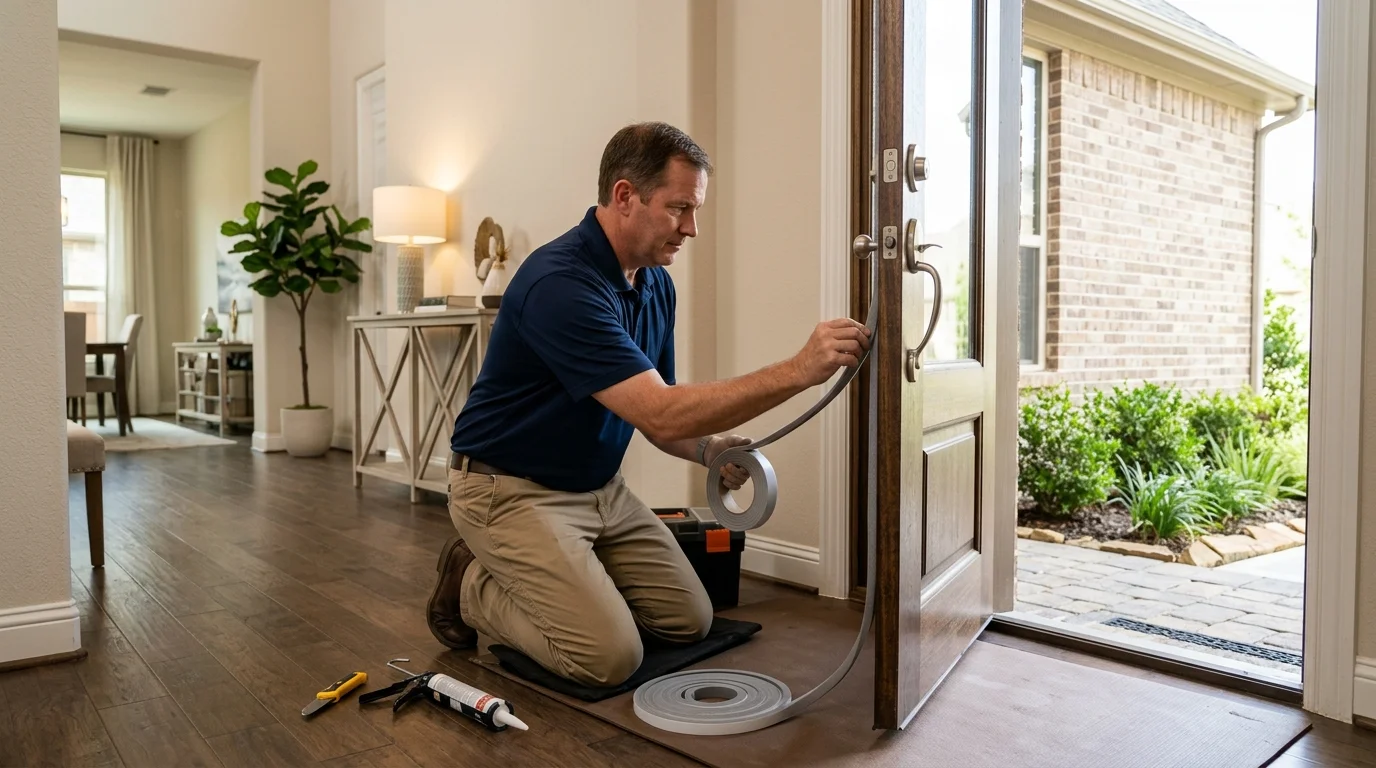
Weatherstripping replacement on exterior doors: For frequently used exterior doors, V-strip tension seal weatherstripping outlasts adhesive foam tape significantly in Killeen's heat. Foam tape compresses quickly at 100-degree temperatures and needs replacement every one to two years. V-strip lasts five to ten years. A door that lets you feel outside air when you hold your hand near the frame while the AC runs needs new weatherstripping immediately. Materials cost: $15 to $35 per door.
Door sweep replacement: The sweep at the bottom of the door seals the gap between the door bottom and the threshold. When you can see light under a closed exterior door, the sweep has failed. Replacement sweeps are $12 to $30 and attach with screws to the bottom of the door. This is a 15-minute repair with a screwdriver that eliminates a direct outdoor air pathway.
Electrical outlet gaskets: Foam insulating gaskets fit behind outlet and switch plates on exterior walls. A pack of 10 costs about $4. Removing the plate, pressing the gasket in, and replacing the plate takes about two minutes per outlet. Done across all exterior wall outlets, the combined reduction in air infiltration is noticeable.
Exterior window and door caulk: Use a paintable siliconized acrylic exterior caulk for window frames. Scrape out any cracked or separated caulk completely before applying a new bead. A $6 tube covers several windows. Do this in February or March before the heat arrives, on a dry day when the temperature is between 50 and 90 degrees for proper adhesion and cure.
When to Call a Pro for Air Sealing in Killeen
Some air sealing work exceeds what DIY products and techniques can fix:
Door frames that have shifted: If an exterior door has a visible gap that persists after new weatherstripping is installed, the frame or the door itself has moved out of square. This is a structural adjustment, not a weatherstripping replacement. It involves removing casing, shimming the frame, and reinstalling, which is beyond a materials swap.
Failed window insulating glass: Windows that show fogging or condensation between the panes have a broken factory seal. Recaulking the exterior does not fix this. The glass unit needs replacement. A handyman can handle the installation once you have a replacement unit sourced. Window and frame repair in Killeen.
Attic air sealing and bypass sealing: Sealing the gaps around ceiling light boxes, wiring penetrations, and wall top plates where air moves between the living space and the attic is the highest-impact air sealing work in most Killeen homes. It also requires working in an attic that hits 130 degrees in summer, which is a professional job. The best window for this work is October through February. Attic access and air sealing service in Killeen.
What You Can Realistically Save
A whole-house air sealing effort covering door weatherstripping, outlet gaskets, window caulk, and a door sweep on every exterior door typically reduces air infiltration by 15 to 25 percent in an older Killeen home. On a $200 summer electric bill, that is $30 to $50 per month saved during the peak cooling season. Materials for a full house run $50 to $150. Payback happens within the first or second cooling season.
The best time to do this work is February through April, before Killeen's heat arrives and while outdoor temperatures are mild enough to work comfortably at door and window locations. Call A Better Handyman at (254) 323-2646 or request a free estimate. We serve Killeen, Harker Heights, Copperas Cove, Fort Cavazos, and surrounding Bell County communities.